Calvin Ecosystem Preserve Interview

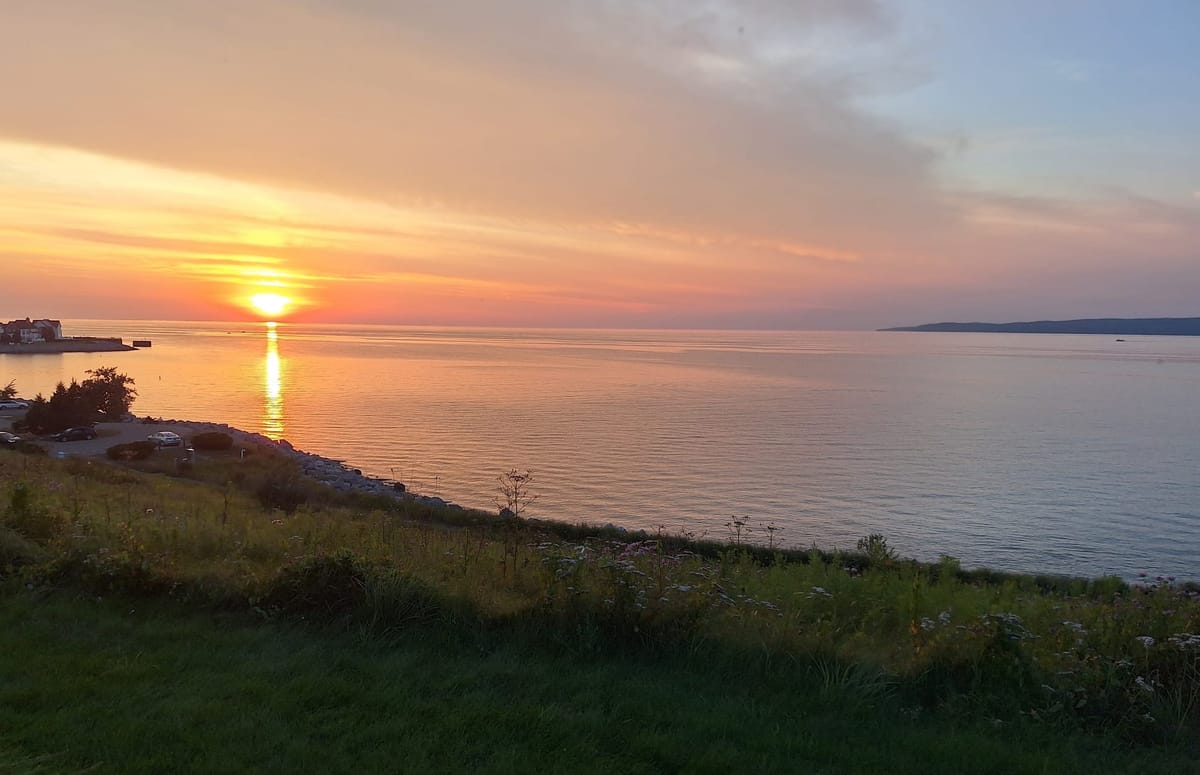
"...without [wonder] we are in danger of thinking that “nature” is elsewhere, in the woods or the safari park or on some eco-resort in Central America, rather than here and everywhere, and dependent, for its safe keeping, on our sense of wonder.(1)"
It was a drowsy August afternoon in 2021 when I drove over to the campus of Calvin University in Grand Rapids, Michigan carefully winding my way through chaotic road construction and the rush of the hospital shift change. Calvin is a Christian school in Grand Rapids, Michigan, a city famous for its density of churches and horticulture-loving Dutch population. Just off the busy highway, I pulled into the Calvin Ecosystem Preserve and Native Gardens, a labor of love by two biology professors that has blossomed over the years into a beloved sanctuary for native plants and their admirers.
Down a short walkway lined with delicate clumps of ornamental grasses, the garden opens up into a burst of color and motion. Bright red cardinal flowers bloom against creamy pink Joe Pye weed in the rain garden as frogs jump between puddles. Pale purple bee balm stems bend under the weight of fat bumblebees and tentative swallowtail butterflies. Chipmunks skitter in the shrub layer below burr oaks, hoovering up the remnants of last year's acorns. After spending so much time indoors because of the COVID-19 quarantine, I was captivated by the sensations of the garden, running my fingers through the feathery grass stems and enjoying the strong scent of mountain mint through my mask.
The program director, Jeanette, had graciously agreed to give me a tour of the gardens, along with a student groundskeeper, Dena. Jeanette is a sharp-eyed woman with a dark ponytail and the unmistakable bearing of a teacher, who took me through her practical approach to blending the science of horticulture, art of landscape design, and mission to educate while periodically pausing to rip out dandelions or point out areas that needed work to Dena. As a lifelong gardener and trained educator, she remained clear-eyed about the struggles of creating an ecosystem preserve in the public eye. She approached those few areas where plants had died or failed to thrive with dogged determination, and regarded the many stunningly successful garden beds with the flinty gaze of a general after a long but victorious battle.
Many alternative landscape visions look like the Calvin Preserve - a meadow that looks in turns stunning and scraggly, a garden that demands not only hours on your knees but also hours of reading and research. The difficulty of shaping a native ecosystem into something recognizable as a "garden" is a challenge which must be preceded by a unique set of desires. A gardener must want a look of floriferous orderliness that comes from a very specific set of cultural expectations. If they are ecologically-minded, a very different set of rules will demand the removal of certain invasive species. Pollinator conservation campaigns might suggest that the gardener plants species that are known to benefit bees and butterflies. All these demands can pile up until anyone but the most determined gardeners throw their hands up in frustration.
A whole library of books have been written about alternatives to the traditional landscape of mowed grass and exotic flowers. These books are often advertised as providing low-maintenance, socially-acceptable alternatives to lawns. Usually the author, a respected horticultural expert, will outline a method for adding garden beds to existing lawn, or for creating swaths of artificial meadow. The introductions are filled with soothing language that assures the reader that the author has plenty of expertise in conventional gardens, and a switch to naturalistic styles will not require the gardener to give up anything they enjoyed about conventional landscaping. The writers pledge that the new styles will be well received by the lawn-loving culture at large.
Photography is such a central focus of the native-plant gardening movement that Jeanette asked me at the end of our interview if my work would be mostly photographs. Indeed most of the alternative landscaping books I have read are much more coffee-table photo spreads than ecological call to action. They're filled with perfectly lit and arranged shots of weed-free, voluminously blooming landscapes and the colorful birds and butterflies they attract. When Jamie, the garden director, briefly joined our conversation, I asked him about his experience of promoting native plants to the public. He looked around at the gorgeous, sun-soaked grounds and smiled, his tanned skin crinkling around his eyes. If this doesn't do it, he told me, we're sunk. I had to agree that the Calvin gardens had completely sold me. But I wondered about those members of the community who don't share my love for wildflowers. Relying on beauty to convince people that we should be engaging in habitat restoration seems so subjective, so toothless.
The problem with these approaches is that they do not challenge the reader to rethink any of the gardening beliefs that are causing the problems they hope to address. Just like lawns, they use a one-size-fits-all approach to landscaping, the meadow garden, that works fairly well in temperate coastal and Midwestern regions of the United States, but is difficult to maintain in areas with different ecosystems like swamps, deserts, or rainforests. These authors do not challenge the idea that humans can or should have complete control of their home landscape, and use that control to shape the plant and animal communities to very specific horticultural ideals. This control is, of course, achieved through massive effort and expense. Digging and turning over one's entire lawn, buying hundreds of nursery-grown plants, learning extensive lists of Latin plant names, and frequent watering and weeding are common suggestions in these "revolutionary" garden texts. But besides their modified planting list, these gardens are no different from a traditional landscape plan.
The cottage garden at the Calvin Preserve is an example of this attempt to sculpt native ecosystems into formal gardens. A charming mix of black-eyed Susan, bee balm, foxglove, and strawberries, Jeanette pointed it out to me as her particular favorite. It was striking to see the familiar rambling style of an English cottage garden portrayed with a new palette of native plants. It struck me as odd, though, how this particular style was the one Jeanette had settled on to demonstrate to community members that native plants could make a beautiful garden around their own homes. The English cottage garden, stripped of its original culture and ecosystem, became the selling point for plants which bloom thousands of miles away from England, hundreds of years away from the original cottage gardens there.
Gardening writers do not frequently question the premise that, although they want to create a nature-like landscape, nature is fundamentally elsewhere. They believe that a domestic landscape is fundamentally unnatural, unconnected to the ecosystem or the Earth as a whole. Sara Stein, author of a very popular book on ecologically sound gardening Noah's Garden, writes; "One can't advise Arizonans to plan their gardens around saguaro cacti that take forty years to reach chest height, insist to Kansans that prairie yards must annually be trampled by bison, sway Californians to the view that canyon fires are ecologically refreshing, or talk a Yankee into entertaining bears. The preservation or restoration of the wilderness is critical but not possible in one's own backyard. One can, however, set aside a portion of this yard to plant, if not altogether naturally, then at least in a way not alien to the theoretical ecosystem in which one lives.(2)" What Stein fails to grasp is that ecosystems are not theoretical, they are a living web of beings equal in their importance to her. Her belief that the wilderness cannot exist in her back yard is challenged again and again by the plants and animals that live around her, but she does not see past her belief that the space around her house can't be anything other than a simulacrum. Actually, every backyard belongs to the Earth. Everywhere is wilderness.
- John Burnside, "Nature is a state of grace that can be experienced by anyone, anywhere." The New Statesman, January 5 2022, https://www.newstatesman.com/culture/nature/2022/01/nature-is-a-state-of-grace-that-can-be-experienced-by-anyone-anywhere.
- Sara Bonnett Stein, Noah's Garden: Restoring the Ecology of Our Own Back Yards (Boston: Houghton Mifflin, 1995) 44.