Self-Willed Life

Migrante (Migrant) by Rafael Calderón-Parra
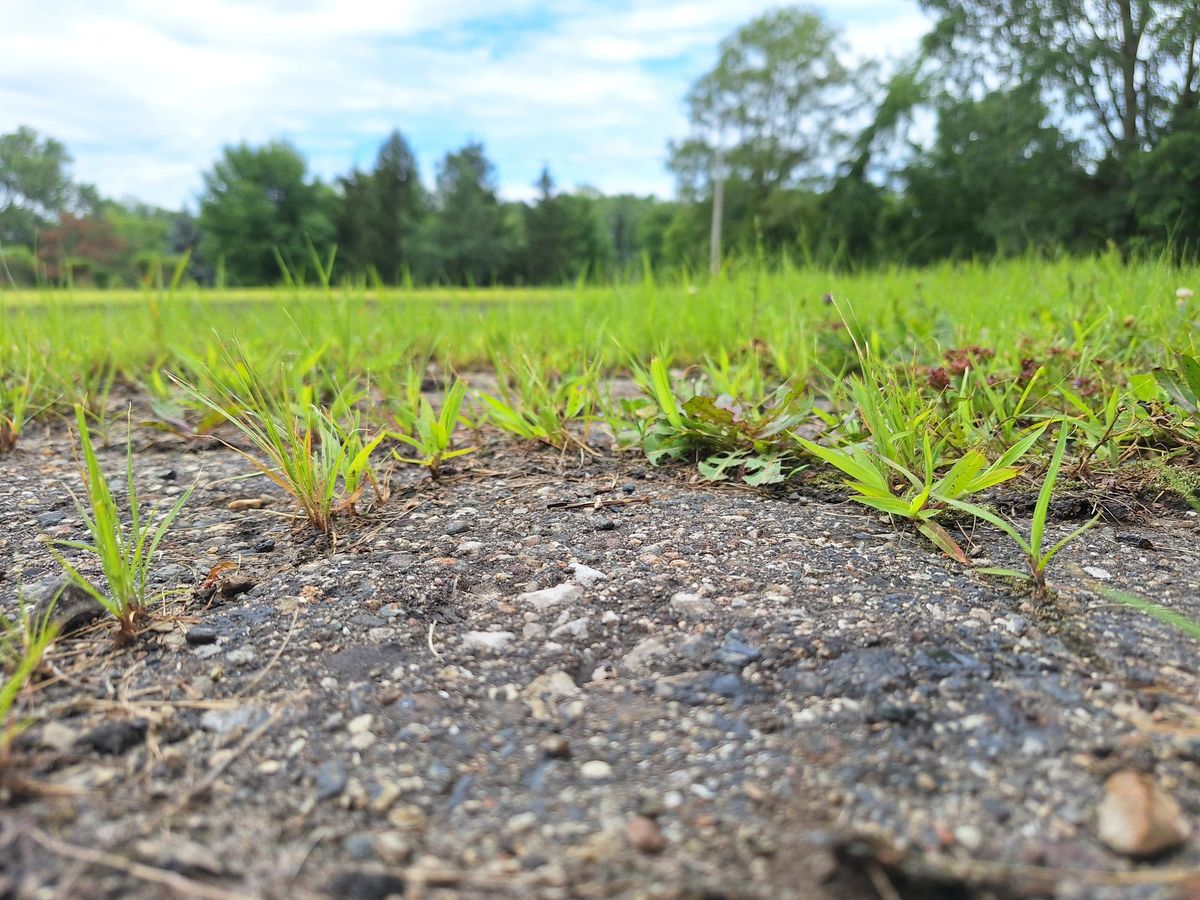
The great nemesis of the landscaper is self-willed life. Ornamental plants that up and die where they've been carefully planted, weeds that sprout where they're not wanted, rabbits that prefer eating the former to the latter. If landscaping is imposing our will on the landscape, the will of the landscape is an obstacle.
Consider the example of a maple seedling growing next to a daylily in a parking lot median. This is a fairly common occurrence throughout the midwestern or eastern United States. The maple seedling is seen as the weed, while the daylily is ornamental. This is strange, because the maple is native to this land, requires no human work to plant, and will grow to store more carbon and purify more air and water than the daylily. The maple tree belongs there. It is the product of millennia of evolution with all of the insects, birds, bacteria, and animals around it. The daylily, though, was brought from another ecosystem. Insects around it can’t even recognize it as food because it is so foreign. Many ornamental varieties are sterile, so they can’t even continue their life cycle. Which of these plants should be considered undesirable?
Like that little maple seedling, ecosystems can actually solve problems for humans when we work together with them. The value of ecosystem services is a stunningly underestimated topic that involves no less than our survival on the planet. We all know that trees breathe in complement to us, taking in our carbon dioxide and releasing oxygen. But the environment around us also purifies water and air, recycles everything that dies, stores energy, and creates hospitable climates. We cannot recreate these systems synthetically. It deserves repeating - we cannot engineer these systems for ourselves. But we are cutting down our very lungs to make way for lawns.
Picture all the interlocking parts of a river ecosystem. Flowing water arrives from thousands of miles around and continues along to the sea, carrying nutrients and algae. Mollusks and invertebrates filter food out of the water, recycling the waste of fish. Fish keep algae populations in control and are eaten by birds. Trees drop their seeds to be carried by the water - those trees whose roots are holding the bank in place.
All these interactions and thousands more take place every day. Science journalist Ed Yong, on the stunning complexity of our microbiomes, writes; "every individual animal, whether human or coral, is an ecosystem in itself. It grew up under the influence of its microbes and continues to engage them in a lively negotiation.(1)" No supercomputer could track all of the movement, the genetic diversity, the cycle of predation, death and birth, the temperature fluctuations, the minute changes of natural selection in an ecosystem, let alone in our own body.
The intelligence and power of these interlocking systems enfold us in a beautiful web, like the embrace of a mother. The idea of a Mother Earth is not necessarily just a metaphor, either. According to philosopher Viola Cordova: "This Earth, this planet, will create its own unique beings out of its own materials... the Earth becomes "parent" not only because of her act of creation but because of her continued sustenance of her creations. In this latter sense the Earth exists as a literal mother.(2)" Cordova reminds us that the very minerals in the ground beneath us are also present in our bones. Botanist Robin Wall Kimmerer writes, "The land loves us back. She loves us with beans and tomatoes, with roasting ears and blackberries and birdsongs. By a shower of gifts and a heavy rain of lessons. She provides for us and teaches us to provide for ourselves. That's what good mothers do.(3)" Our interconnectedness runs deep, from our creation out of the materials of the Earth to the inevitable return of those materials we have borrowed.
We, the beings of Earth, truly belong together. We can see this in the way certain animals stomachs’ have the perfect acidity to unlock certain seeds’ growth, in the way grazing can increase the vigor of grasses, and in the way flowers have evolved to please a bee’s aesthetic sense. The fact that we share many of those beauty ideals with bees should indicate clearly to us that we are truly all related. This relationship carries with it the responsibility of reciprocity; the demand that we take care of the land that cares for us. Avoiding reciprocity is a strategy that can increase short term profits, but comes with consequences. Climate journalist Naomi Klein writes, "Just as Watt's [steam] engine promised, once purchased, they produced power wherever and whenever their owners wished - the ultimate nonreciprocal relationship. But what we have learned from atmospheric science is that the give-and-take, call-and-response that is the essence of all relationships in nature was not eliminated with fossil fuels, it was merely delayed, all the while gaining force and velocity(4)."
All evolution is coevolution. We didn’t become humans in response to a static, dead landscape. We became humans as oaks were becoming oaks, as foxes were becoming foxes. Alfred Russel Wallace, co-discoverer of evolution, wrote, "every species has come into existence coincident both in space and time with a pre-existing closely allied species.(5)" We have all arrived at this place together, dancing together around the planet. The scientific principle of the conservation of genetics means that most genetic information is shared across all species. All bacteria, fungi, plants, and animals share at least some basic genetic material. In many cases we share a vast majority. Self-creation, competition, and reciprocity balance and combine, resulting in the ecosystem.
As our relations with the world become increasingly violent, we can see some troubling results of our coevolution. Our overuse of antibiotics for human illness and as an additive in the food farm animals has given rise to antibiotic resistant strains of bacteria that threaten our survival as a species. Wildfire suppression and introduced species have led to even stronger wildfires in the western U.S. Climate change is one area where perhaps the dance of coevolution has turned into a fist fight. In response, the Earth threatens us with annihilation - apocalyptic floods, famines, and droughts.
Rewilding can offer a hand out in reconciliation. It is when we seek to understand, accept, and even appreciate the self-will of other beings that we can choose to live in balance. If we let the maple seedling grow, we can gain an ally in our back yard, instead of creating an enemy.
- Ed Yong, "I Contain Multitudes, The Microbes Within Us and a Grander View of Life," (New York: Ecco, 2016) 231.
- Kathleen Dean Moore, "How It Is: The Native American Philosophy of V.F. Cordova," (Tucson: University of Arizona Press, 2007) 114.
- Robin Wall Kimmerer, "Braiding Sweetgrass: Indigenous Wisdom, Scientific Knowledge, and the Teachings of Plants," (Minneapolis: Milkweed Editions, 2015) 122.
- Naomi Klein, "This Changes Everything: Capitalism Vs. The Climate," (New York: Simon & Schuster, 2015) 175.
- Alfred Russel Wallace, "On the Law Which Has Regulated the
Introduction of New Species," (S20: 1855).