
The Grave Lawn; a review of Stigma (1977)

Stigma is a short film which is part of the British supernatural anthology series A Ghost Story for Christmas. Written by Clive Exton and directed by Lawrence Gordon Clark, it premiered on BBC1 on December 29th, 1977(2). The film opens with a car cutting through English countryside. A long suffering mother and her grumpy teenage daughter are travelling to their new home. As they arrive, an excavator rumbles up through the hedgerow, emerging onto the lawn.

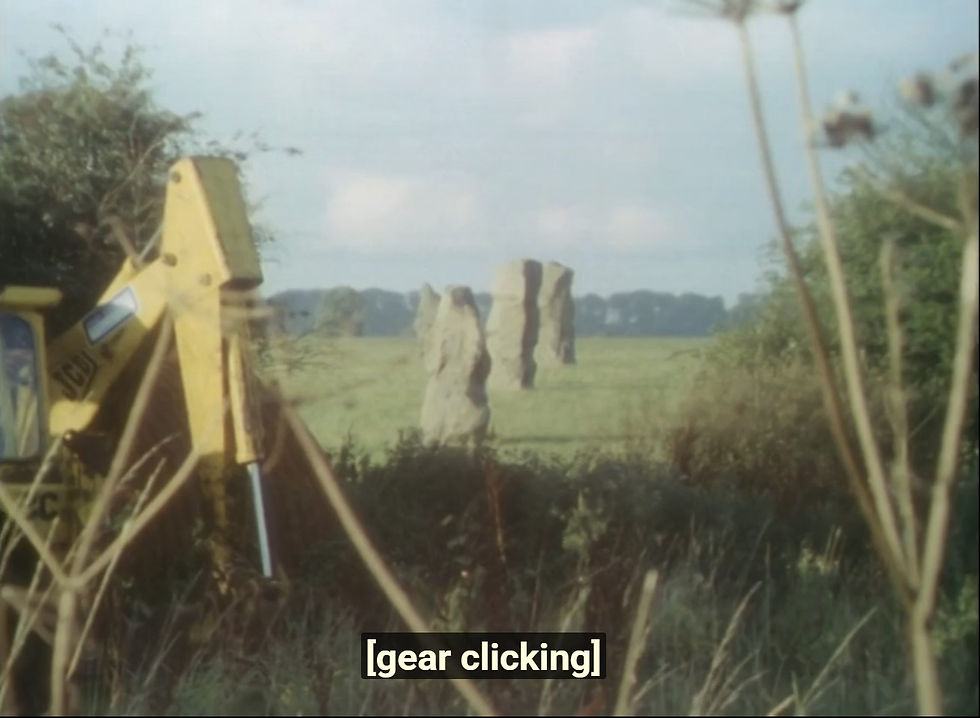
Workers emerge from the equipment and lay out the doom that awaits this family. They have been ordered to create an expansive lawn by the absent patriarch of the family. But there is an outlier from the nearby standing stones in their way. It looks fine where it is, and would be extremely difficult to move, they reason. But the mother character, Katharine, insists that her husband wants a perfect lawn.
The workers push their excavator to the limit to try to shift the "York stone." The heavy chain rattles, the tires skid in the weeds, and a powerful gust of wind blasts in Katharine's face.

Clearly shaken by some strange internal experience, Katharine retreats to the cottage. The soft focus slowly shifts from the standing stones out the window to Katharine's troubled face. She is soon called back to the present reality, though, by the demands of making dinner for her husband, who is on his way to their new home.
This is when Katharine begins to see the blood. Oozing out of the skin under her right breast, staining her hands, her torso, even her face, is a gush of blood. With shaking hands, she strips in the bathroom, searching for the Christlike wound in her side. All she finds, though, are the smears of blood on her pale skin.
After he arrives for dinner, her husband Peter, played by Peter Bowles, is quick to criticize her for a red wine stain on her dress (or is it blood?) as she serves him. The next morning he's even more irritated by her failure to serve him breakfast, as well as the noise of the crane on the lawn. But when he trudges upstairs to reproach her, he finds the blood. Blood soaks Katharine's nightgown, blankets, and mattress, and flows down to the floor.

Peter frantically searches for a non-existent wound, scrambling through the sopping bedding. He calls the doctor, his daughter Verity, the ambulance. Behind the house, the workers have finally gotten the crane to lift the stone. As it shakily emerges from its ancient placement, it reveals a human skeleton beneath. As the doctor arrives at the front door to examine Katharine with Peter, the workers arrive at the back door to tell Verity about the skeleton.
Peter, the doctor, and Katharine speed away to the hospital in a car where Katharine dies of blood loss despite having no visible wound. Verity, not knowing yet that her mother is dead, stands over the ancient grave and peels an onion with blood red nails. It is the grave of a witch, she intones with no feeling, sealed by the stone.

This immersive little film uses the lawn as the stage for a uniquely British meditation on the tension between ancient and modern. The standing stones loom in the background, a solidly physical reminder of humanity's antiquity. They are the roots to the land that our characters can't escape. The family in the story move in from the city, eager to change a landscape they don't fully understand. The hubris of disturbing the standing stone is punished with the curse of repeated history. The mundane humiliation of Peter's critical sniping at Katharine is echoed by the overt violence of ancient witch hunts.
The family does not understand the power or the value of the standing stone. This ancient natural power is so easily dismissed in favor of the lawn, symbol of keeping-up-with-the-Joneses, of orderliness, of money. But like Verity's onion has been unearthed, a skeletal magic emerges from the soil. The family can't escape the earthy, decomposing, ancient truth of the land.
Like the family in Stigma, we stand on a dangerous landscape. Lawns are causing habit loss, species extinction, aquifer depletion, and climate change. Our standing stone is the survival of nature itself, and too many people are blind to its power.
The harms are apparent to those who look. The communities at sea level, the scientists who study disappearing species, the farmers running out of water - they can feel the bleeding. Our relationship with our landscape is an invisible wound that we dismiss at our own peril.
Clark, L.G. (Director). (1977). Stigma [film]. British Broadcasting Company.
Stigma (1977 film). Wikimedia Foundation. 1/27/26. Accessed 5/14/26. https://en.wikipedia.org/wiki/Stigma_(1977_film)


